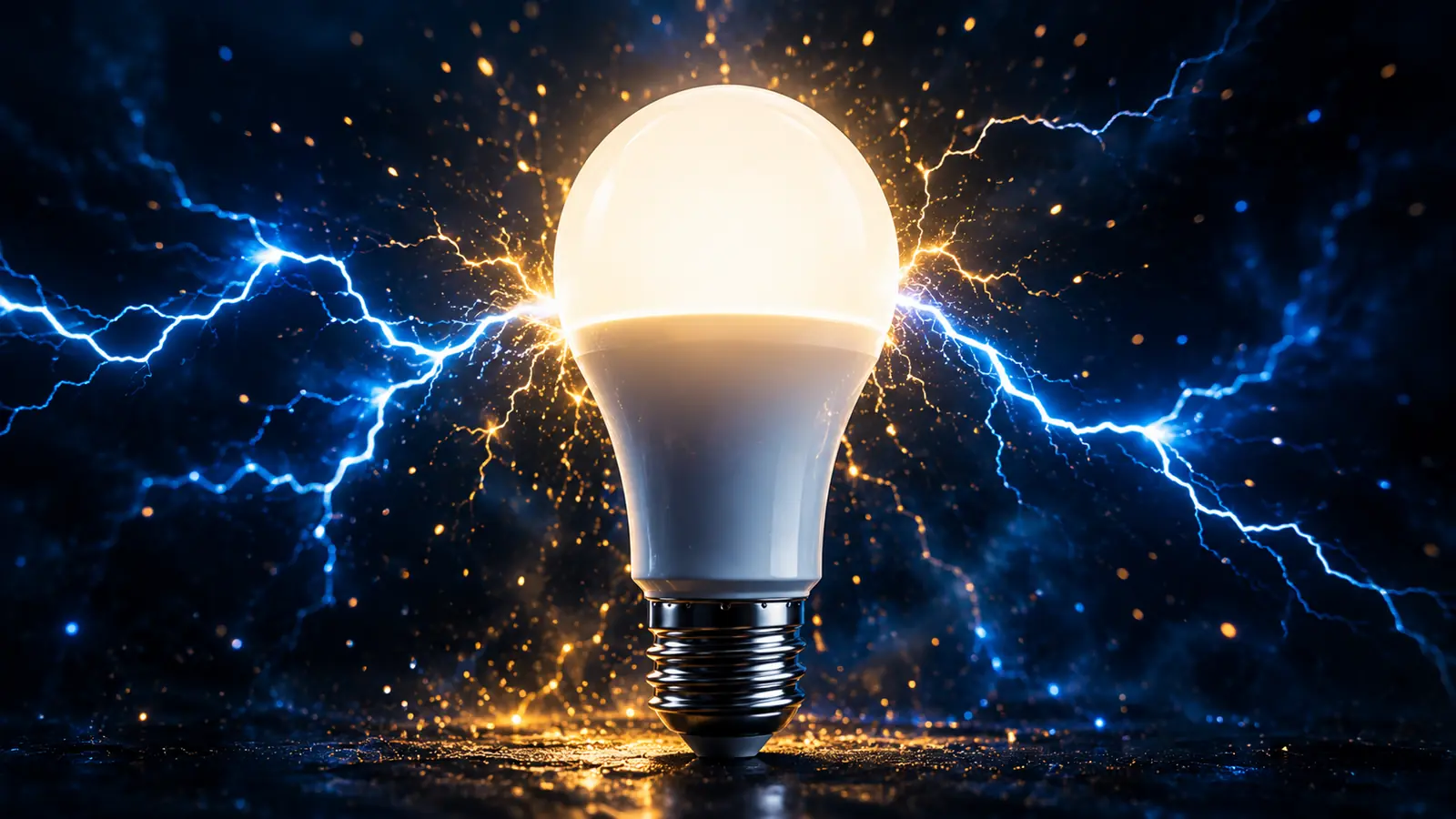
Voltage swings and surges are the silent killers of LED lights. Learn the practical steps that help your bulbs last their full lifespan.
A good LED bulb should last tens of thousands of hours. Yet many households in Nepal find their lights dimming, flickering, or failing far too soon. The most common reason is not the bulb itself — it is the power supply feeding it.
What voltage fluctuation does to an LED
Nepal's grid commonly sees voltage swings, brownouts, and sudden surges, especially during load changes and storms. Inside every LED is a small driver circuit that converts mains power into the steady current the diodes need. Repeated over-voltage and spikes stress this driver, and it is usually the driver — not the LED chip — that gives out first.
- Surges (sudden high-voltage spikes) can damage the driver instantly.
- Sustained over-voltage slowly cooks components and shortens life.
- Low voltage can cause flicker and make lights run poorly.
Look for a wide input range
HEAVEN LED bulbs are designed to run on a wide 85–300V AC input. A wide operating range means the bulb keeps working smoothly through the everyday swings that would trouble a narrow-range product.
Practical ways to protect your lights
- 1Choose wide-voltage LEDs: a wide input range (like 85–300V) is your first line of defence against everyday fluctuation.
- 2Add surge protection: a surge protection device (SPD) at your distribution board helps absorb spikes before they reach your fixtures.
- 3Use a stabiliser for sensitive areas: where voltage is very unstable, a voltage stabiliser keeps the supply within a safe band.
- 4Avoid overloading circuits: too many high-draw appliances on one line can worsen dips and spikes.
- 5Check your wiring and earthing: loose connections and poor earthing cause flicker and premature failure. Have an electrician inspect older installations.
Signs your lights are suffering from power issues
- Flickering or buzzing, especially when other appliances switch on
- Bulbs that fail within months rather than years
- Lights that are noticeably brighter or dimmer at different times of day
- Multiple bulbs failing on the same circuit
If you see several of these signs together, the problem is likely your supply, not the bulbs. Protecting the circuit will save you far more than repeatedly replacing lights.
Warranty and peace of mind
HEAVEN LED products are CE & RoHS certified and carry up to a 2-year warranty on A and T-shape bulbs. Keep your proof of purchase and original packaging so any genuine manufacturing fault can be handled smoothly.